Thursday, November 8, 2012

The Printing Press

The technogy was getting more and more developed...

Incunabula


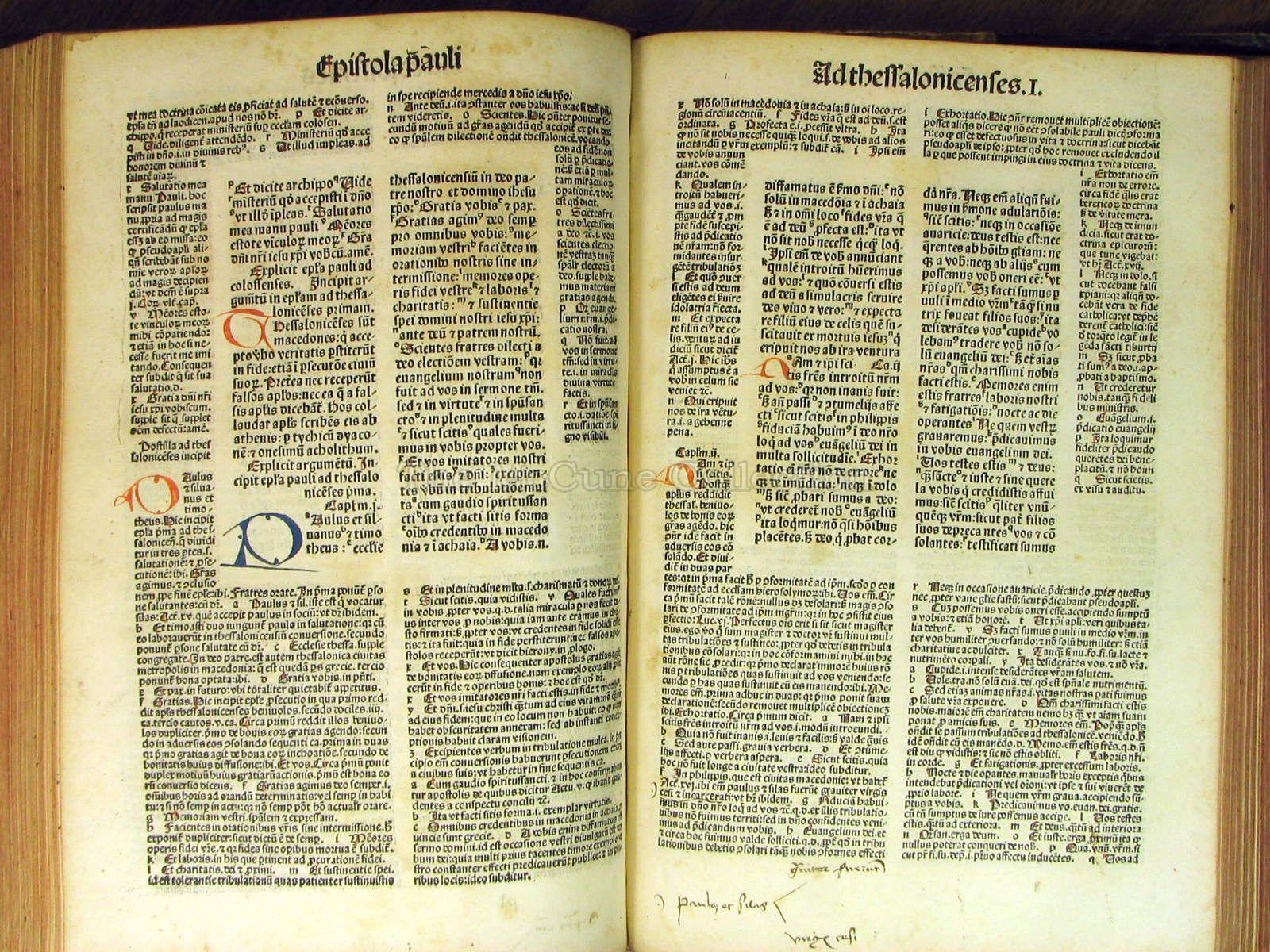
An incunabulum is a book, single sheet, or image that was printed -not handwritten- before the year 1501 in
Europe. These are usually very rare and fragile items whose nature can only be verified by experts. The origin of the word is the Latin incunabula for "swaddling clothes", used by extension for the infancy or early stages of something.

The first recorded use of incunabula as a printing term is in a pamphlet by Bernard von Mallinckrodt, "Of the rise and progress of the typographic art", published in Cologne in 1639, which includes the phrase prima typographicae incunabula, "the first infancy of printing". The term came to denote the printed books themselves from the late 17th century.

There are 2 types of incunabula, which are the xylographic and the typographic. The xylographic is made from one carved or sculpted block for each page and the typographic is made with movable type on a printing press in the style of German Johannes Gutenberg, whom I will explain later on. The incunabula does not reflect any important developments in the printig process (around 1500). It generally refers to the earliest printed books, completed at a time when some books were still being handwritten/hand-copied. There became a great diversity in the texts, that were chosen for printing anthe styles in which they appeared, thanks to the spread of printing.

During this period a myriad of typefaces were occured in local forms of writing or derived from the various European forms of Gothic script, or from documentary scripts, like most of Caxton's types. Tyes modelled on humanistic hands, especially in Italy, and these typefaces are still used today, hardly modified, in digitaal form.

author:Brunschiwig, Hieronymus


Wednesday, November 7, 2012

The Art of Book

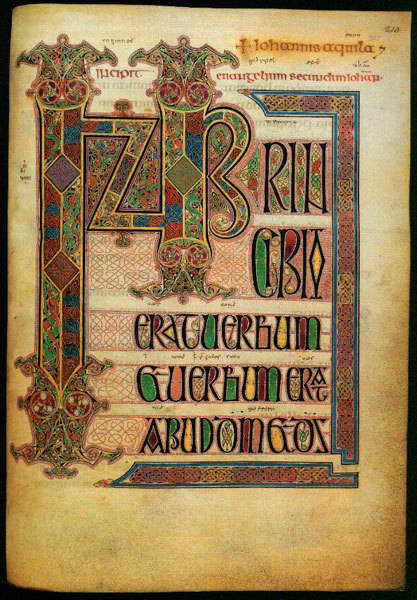
Those days were dark in the Medieval Europe, so always reminded as the darkest period : the Third Century. The plague is the biggest reason for this darkness, but there were some other reasons, too, like fear, darkness, witch-hunts, illiteracy...The interesting thing is that, the magnifiscant illuminated manuscripts were occured during this dark period, in cold monasteries. The colophones of their books were the only testimonies of their really short, depressing lives.

An illuminated manuscript is a manuscript in which the text is supplemented by the addition of decoration, like decoratedinitials, borders (marginalia) and miniature illustrations. In the most strict definition of the term, an illuminated manuscript only refers to manuscripts decorated with gold or silver, but in common usage and modern scholarship, the term is now used to refer to any decorated or illustrated manuscript from the Western traditions. (Comparable Far Eastern works are always described as painted, as are Mesoamerican works, Islamic manuscripts are usually referred to as illuminated but can also be classified as painted.)

The earliest surviving substantive illuminated manuscripts are from the period AD 400 to 600, initially produced in Italy and the Eastern Roman Empire The significance of these works lies not only in their inherent art historical value, but in the maintenance of a link of literacy offered by non-illuminated texts as well. Had it not been for the monastic scribes of Late Antiquity, most literature of Greece and Rome would have destroyed in Europe; as it was the pattern of textual survivals were shaped by their usefullness to the severely constricted literate group of Christians. Illumination manuscripts, that were used to increase the power of ancient document, helped their preservation and informative value in an era when new ruling classes were no longer literate.

The majority of surviving manuscripts are from the dark Middle Ages as I wrote before, but actually a myriad of the illuminated manuscripts survive from the Renaissance. The majority of these manuscripts are of a religious nature. Most illuminated manuscripts were created as codices, that has took the place of scrolls. A few manuscript fragments survive on papyrus, vellum or parchement. The most important manuscripts were written on qualified parchement, named vellum.

Apart from their historic value as documentaries, they were the only surviving examples of painting.


A video of a brief history of Illuminated Manuscripts


from "The Book of Kells"


Tuesday, November 6, 2012

The Greek Alphabet

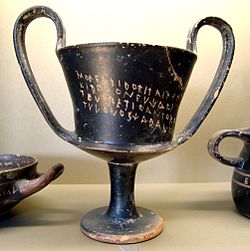
The Greek alphabet is actually the source for all the modern scripts in Europe. With the approval of the Phoenician language the history of the Greek Alphabet has begun. The Phoenician Alphabet represented only consonants. (abjad) Some historians accept the Greek Alphabet as the first true alphabet.

People use the alphabet even on mugs now.

a t-shirt with a letter from the Greek Alphabet.


The Phoenician Alphabet

Another important alphabet is the Phoenician Alphabet that was developed in the city-states that grew on the eastern shore of Mediterranen Sea, Phonecia. These city-states were at the center of trade. "The Phoenicians were peaceful, seafaring people, expert in navigation and trade, and beginning aroun 3200 B.C., were the first to explore the Mediterranean Sea in boats made of cedar." (http://maryourmother.net) To communicate with other cultures -that Phoenicians were making trade with- they developed the Phoenician Alphabet, around 1400 B.C. This alphabet is acyually a continuation of the proto-Canaanite Alphabet, because the Phoenicians were the descendants of the Bronze Age Canaanites. Their trade used to reach even Atlantic coast of Africa and the Black Sea.

The Mediterranean world and Greece has received the alphabet, which had 22 letters, based on sound, different from many symbols şn cuneiform and hieroglyphics. As a conclusion, "The Phoenician Alphabet was based on the principle that one sign represents one spoken sound. Thanks to the Phoenician Alphabet Greek and Berber alphabets have risen.


Now, the we can see the Phoenician alphabet functioning as an ornamental use. For example you can find a mouse padd or mobile phone cases that has Phoenician letters on it.


Friday, October 26, 2012

The Beginning of the Alphabet


An alphabet is a standard set of letters (basic written symbols/graphemes) which is used to write one or more language based on the general principle that the letters represent phonemes (basic significant sounds) of the spoken language. This is in contrast to other types of writing systems, like aslogographies, in which each character represents aword, morpheme or semantic unit, syllabaries, in which each character represents a syllable.
A true alphabet has letters for the vowels of a language as well as the consonants. The first "true alphabet" in this sense is believed to be the  Greek alphebet, which is a modified form of the  Phoenician alphabet, but actually the history of the alphabet starts in ancient Egypt. The first pure alphabets (properly, "abjads", mapping single symbols to single phonemes, but not necessarily each phoneme to a symbol) appeared around 2000 Bc in Ancient Egypt, as a representation of language improved by Semitic workers in Egypt, but by then alphabetic principles had already been instilled into Egyptian hieroglyphs for a period of one thousand years. Most other alphabets in the world today either descended from this discovery, or were directly inspired by its design, including the Phoenician and Greek alphabet.
The Proto-Canaanite alphabet, like its Egyptian prototype, represent just the consonants, which is a system called, an abjad. It is possible to trace nearly all the alphabets ever used, most of which descend from the younger variant of the script. To illustrate it, the Aramatic alphabet, has evolved from Phoenician in the 7th century BC.


The Phaistos Disc
It is an archeological discovery nearly from the middle or late Minoan Bronze Age. Its target and meaning, and its original geographical place of manufacture, remain disputed, making it one of the most famous mysterious archeological find, which is now at the Archeological Museum of Herakleion in Crete, Greece.

More over, "the disc of Phaistos is the most important examle of hieroglyphic inscription from Crete and was discovered in 1903 in a small room near the depositories of the "archive chamber", iin the north-east apartements of the palace, together with a Linear A tablet and pottery dated to the beginning of the Neo-palatial period (1700-1600 B.C.)

The exact location of Phaitos was first determined in the middle of the19th century by the British admiral Spratt, while the archeological investigation of the palaca started in 1884 by the Italians F. Halbherr and A. Taramelli.

According to the mythology, Phaistos was the seat of king Radamantis, brother of king Minos. It was also the city that gave birth to the great wise man and soothsayer Epimenidis, one of the seven wise men of the ancient world. Excavations by archeologists have unearthed ruins of the Neolithic times (3000 B.C.). During the Minoan times, Phaistos was a very important city-state. Its dominion, as its peak, streched from Lithinon to Psychion and included the Paximadia islands. The city participated to Trojan war and later became one of the most important city-states of the Dorian period.

Phaistos continued to florish during Archaic, Classical and Hellenistic times. It was destored by the Gortynians during the 3rd century B.C. In spite of that, Phaistos continued to exist during the Roman period." (http://world-mysteries.com)


On the disc that was made of clay, hieroglyphes were arranged in a spiral zone. There are group of signs, which are separeted from each other with lines. Each of the group represents one word. Also there are 241 tokens (symbols) on the disc, including 45 unique signs, that symbolise every-day things. There are traces of corrections made by the scribe (the recorder).
Because of he disc a big speculation have been occured during the 20th century. Archeologists tried to decode the code behind the disc's signs.


Phaistos city-state


Tuesday, October 16, 2012

Pictograms, Ideograms and Logograms


A Pictograph or a pictogram is a symbol representing a concept, object, activity, place or event by illustration.

Pictography is a form of writing whereby ideas are transported through drawing, which is the basis of cuneiform and hieroglyphs. "Early written symbols were based on pictograms (pictures which resemble what they signify) and ideograms (pictures which represent ideas). It is commonly believed that pictograms appeared before ideograms. They were used by various ancient cultures all over the world since around 9000 BC and began to develop into logographic writing systems around 5000 BC."Pictograms are still in use as the main medium of written communication in some non-literate cultures in Africa, The Americas, and Oceania, and are often used as simple symbols by most contemporary cultures. ( http://www.citrinitas.com).

An ideogram or ideograph is a graphical symbol that represents an idea, rather than a group of letters arranged. Wayfinding signages, that can be found in airports or other environments, where there are people from different places of the world, there fore don't speak the same language. These signage are used worldwide, so everyone can understand. The term "ideogram" is commonly used to describe logographic writing systems. To illustrate it, Egyptian hieroglyphs and Chinese characters are like that. Although, symbols in logographic systems usually represent words or morphemes, not pure ideas.

"A logogram or logograph, is a single grapheme which represents a word or a morpheme (a meaningful unit of language). This stands in contrast to other writing systems, such as alphabets, where each symbol (letter) primarily represents a sound or a combination of sounds." (http://www.citrinitas.com)

Far Eastern Ideogramatic Writing Systems

A Chinese character is a logogram used in writing Chinese, Japanese and Korean . It is possible that precedents appeared as early as 8000 years ago, and a complete writing system in Chinese characters was developed 3500 years ago in China, which is the oldest surviving writing system. Chinese characters are extracted directly from individual pictograms or combinations of pictograms and phonetic signs.

The number of Chinese characters contained in the Kangxi dictionary is approximately 47,035.


Tuesday, October 9, 2012

Rocks and Caves

As you understand from the title, this blog is going to be about the History of Visual Communication Design, that actually had started many many years ago...

First of all, visual communication means, "the communication of ideas throufh the visual display of information. Primarily associated with two dimensional images, it includes: art, signs, photography, typography, drawing fundamentals, colour and electronic resources. Recent research in the field has focused on web design and graphically oriented usability. It is part of what a graphic designer does to communicate visually with the audience." (from http://www.citrinitas.com)

History of Visual Communication Design has actually started with the paintings on rocks and caves in Europe with Cro-Magnons, who form the earliest known European examples of Homo-sapiens. It is known that they are descending from populations of the Middle-East and lived from about 40,000 to 10,000 years ago in the Paleolithic period of the Pleistocene epoch. Cro-Magnons were anatomically modern. They are only different with their partly stronger physiology and brains that have larger capacity than that of modern humans. After they arrived in Europe (about 40,000 years ago), they brought sculpture, painting, body ornamentation, engraving, music and decoration of utilitarian objects, there.

Tools that were survived by Cro-Magnons comprise of huts (small dwelling), carvings, cave paintings and antler-tipped spears (weapons). By the way, antler means horn of animals in the deer family, so we know that they used to hunt animal not only for food, but to make weapons, too. The remains also suggest that these people knew how to make woven clothing. More over their huts were constructed of rocks, bones, clay, branches and animal fur. It is possible that Cro-Magnons have created the first calender around 15.000 years ago, with their knowledge of painting pictures with manganese and iron oxides.

Cave Paintings

"Cave or rock paintings are paintings painted on cave or rockwalls and ceilings, usually dating to prhistoric times. Rock paintings are made since the Upper Paleolithic, 40,000 years ago. It is widely believed that the paintings are the work of respected elders or shamans." They mostly used to draw/paint large wild animals, like bisons, aurochs, horses, deers and tracing of human hands. Of caurse they have depicted abstract forms, too." (from http://www.citrinitas.com) Researchers think that cave art may have begun in the Aurignacian period (Germany). It is known that these fantastic "modern" looking paintings for the period we live in were drawn with yellow and red ochre, hematite manganese oxide and charcoal.